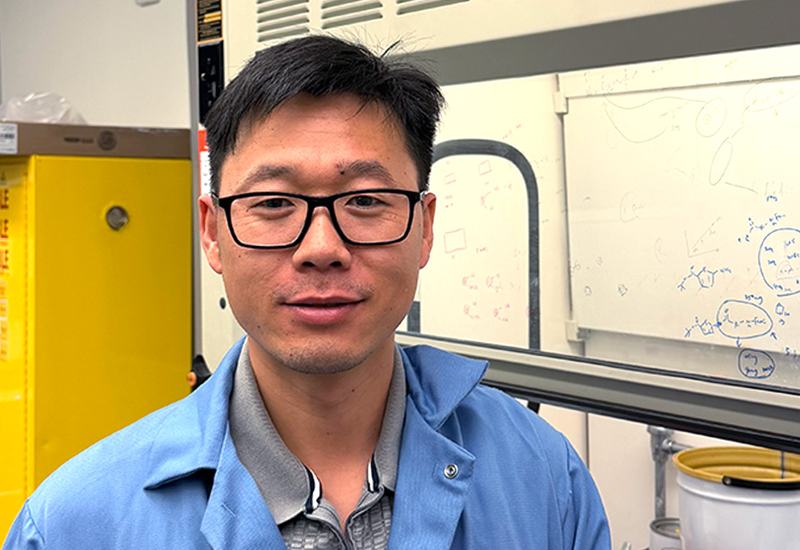
The human proteome presents a daunting challenge to drug developers. Roughly 85 percent of its proteins resist conventional small-molecule targeting. Most approved drugs work by occupying a binding site and blocking activity, a strategy that cannot reach proteins without well-defined pockets. Weijun Gui, who launched his independent laboratory at Syracuse University in August 2025, is building the chemical tools to change that.
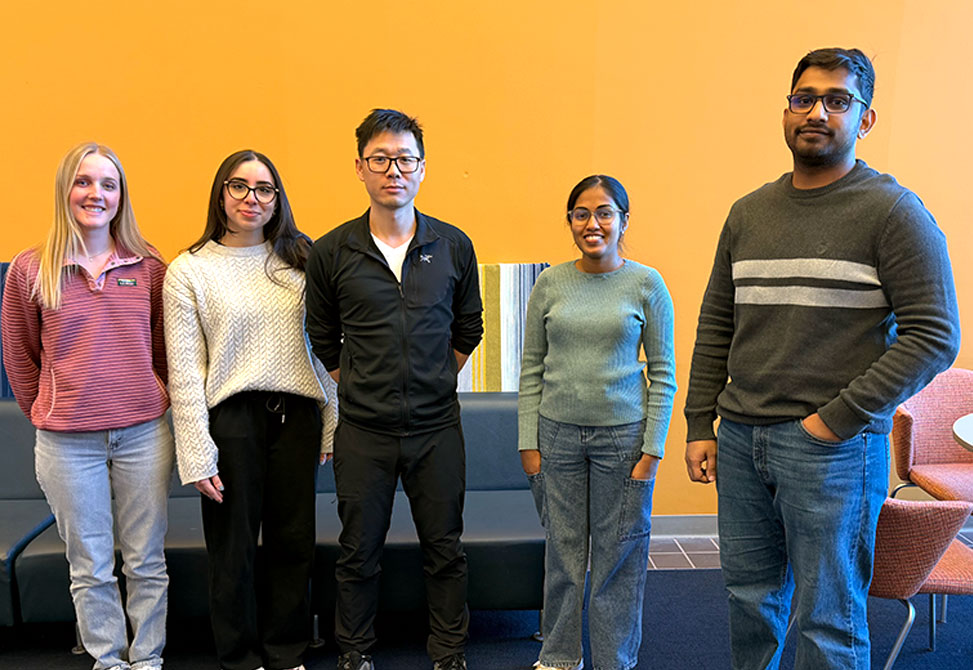
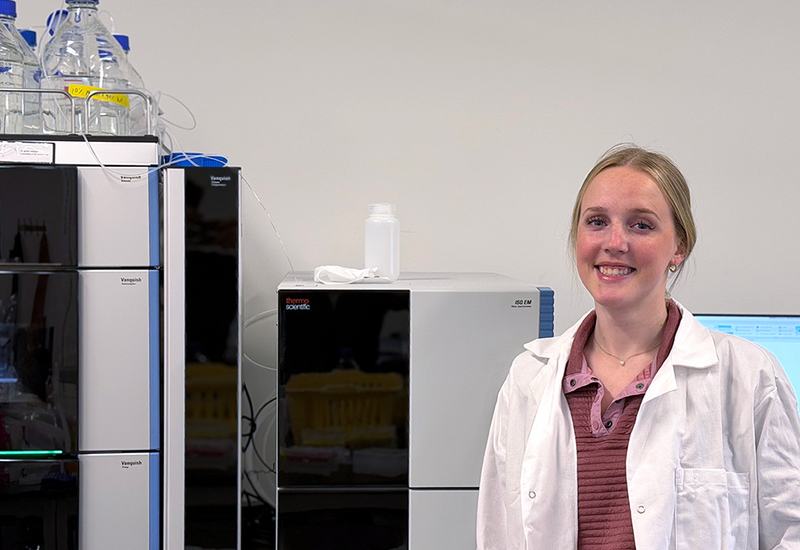
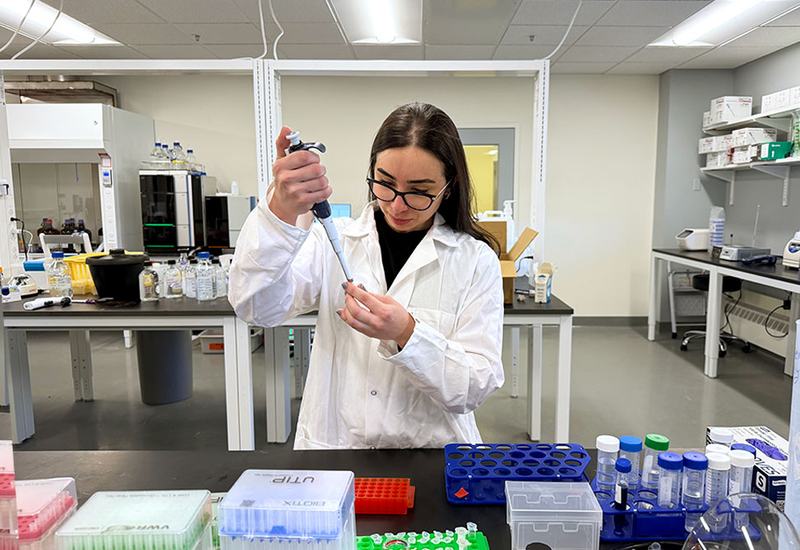
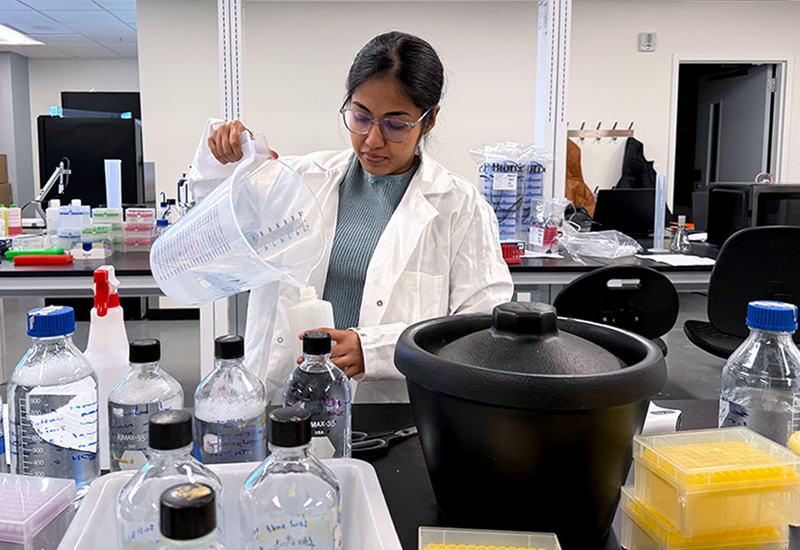
From left to right: Kate Young, Vitoria Fernandes Ferro, Wijun Gui, Hiruni Kandambi, and Janitha Kumarathunga.
Gui completed his doctoral training with Zhihao Zhuang at the University of Delaware, where he developed activity-based chemical probes for deubiquitinating enzymes, the cellular machinery responsible for removing ubiquitin tags from proteins. Ubiquitylation governs a vast network of intracellular signals, including targeted protein degradation by the proteasome. His doctoral work produced cell-permeable probes capable of profiling deubiquitinase activity directly inside living cells, a notable technical achievement reported in the Journal of the American Chemical Society in 2018. That foundation in ubiquitin biology would prove central to everything that followed.
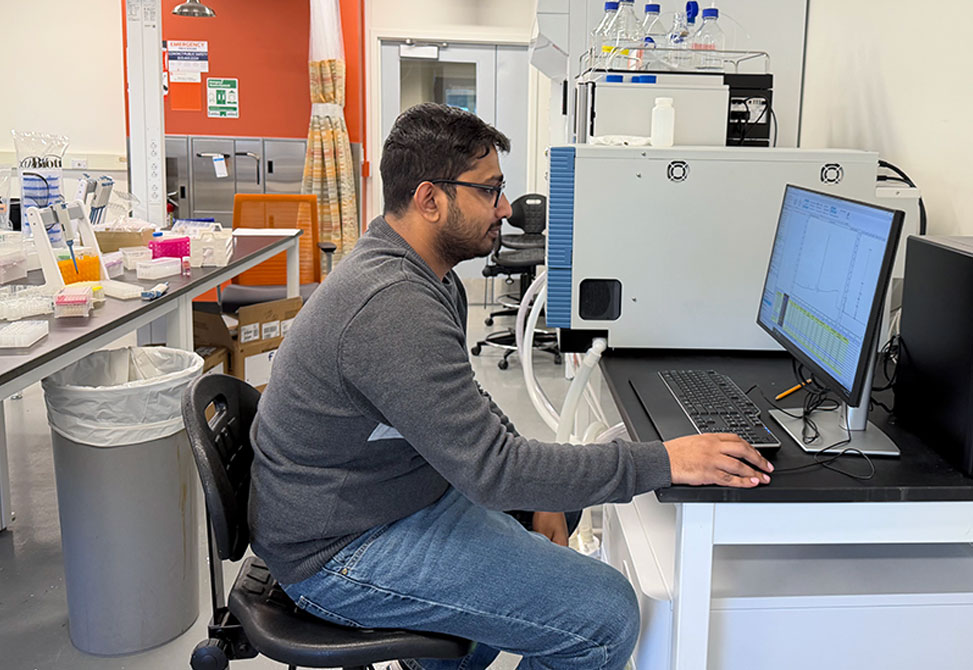
Janitha Kumarathunga
Postdoctoral training with Thomas Kodadek at The Herbert Wertheim UF Scripps Institute for Biomedical Innovation and Technology in Jupiter, Florida extended his expertise into targeted protein degradation. Modern degradation strategies use bifunctional molecules and molecular glues to recruit a target protein to an E3 ubiquitin ligase, marking it for destruction. The critical bottleneck in building such agents is identifying E3 ligase ligands that bind the enzyme without inhibiting it, and most conventional screening platforms cannot make that distinction. Working with colleagues in the Kodadek group, Gui developed an on-resin functional assay that couples small-molecule binding to E3 ligases with enzymatic ubiquitylation of a co-displayed substrate. The work, published in the Journal of the American Chemical Society in 2025, also reports a new ligand for the von Hippel-Lindau E3 complex, validating the platform in practice.
The Gui Lab at Syracuse now extends this approach in two directions. The first project applies the functional one bead one compound screening platform to deubiquitinating enzymes, mining DNA-encoded libraries for non-inhibitory ligands and molecular glues that can modulate DUB activity in new ways. The second project targets the 20S proteasome, seeking activators and molecular glues that drive the degradation of intrinsically disordered proteins, a class of targets responsible for numerous diseases yet notoriously resistant to conventional drug design. Together, these programs place the lab at the frontier of chemically induced proximity, an emerging paradigm that uses synthetic molecules to force interactions between proteins that would not otherwise associate.
The lab opened officially on August 27, 2025, and has assembled an energetic team with impressive speed. Graduate students Janitha Kumarathunga and Saimon Shahriar joined in fall 2024, followed by Kate Young, Hiruni Kandambi, and Vitoria Fernandes Ferro in late 2025. Undergraduate researcher Joseph Martino joined in January 2026, and summer research fellows Kenji Almonte and Samantha Oakes presented their first projects in 2026. With a research group assembled in under a year, the pace of growth signals strong departmental confidence and a compelling research vision. The Gui Lab is actively recruiting graduate students, postdoctoral researchers, visiting scholars, and undergraduates with backgrounds in chemical biology, medicinal chemistry, and biochemistry.
We welcome Weijun into the APS community and look forward to following his progress here and at future APS symposia.